Accurate point forecasts are highly useful in many economic and financial activities. They help us understand the expected outcome for a given task, whether that task involves forecasting demand, modelling portfolio performance, estimating revenue, or planning around economic conditions.
However, some decisions require more than a single expected value. Risk management, portfolio optimisation, and many algorithmic trading strategies depend on understanding plausible downside and upside outcomes. In these settings, the central forecast is useful, but the range of possible outcomes is often more important.
This is where distributional forecasting becomes useful. In this article, we introduce one of the most practical methods for distributional forecasting: quantile regression.
From Point Forecasts to Conditional Quantiles
A traditional linear regression model usually estimates the expected value of an outcome. In simple terms, it is trying to estimate the mean.
Quantile regression takes a different approach. Instead of estimating only the expected outcome, it estimates conditional quantiles of the outcome distribution.
| Quantile | Interpretation |
|---|---|
| 10th percentile | Adverse or downside case |
| 50th percentile | Median case |
| 90th percentile | High or upside case |
These percentile forecasts can support practical decision-making in several contexts:
- Financial analysts might use downside quantiles to inform stop-loss logic, reduce portfolio exposure, or plan for adverse market conditions.
- Economists might use quantile forecasts to explore downside and upside scenarios for employment, inflation, or output.
- Managers might use lower quantile forecasts to prepare for weak cashflow, revenue shortfalls, or demand reductions.
The key advantage is that quantile regression does not only ask, "What is the expected outcome?" It also asks, "What would a low, typical, or high outcome look like under current conditions?"
Conditional Forecast Ranges
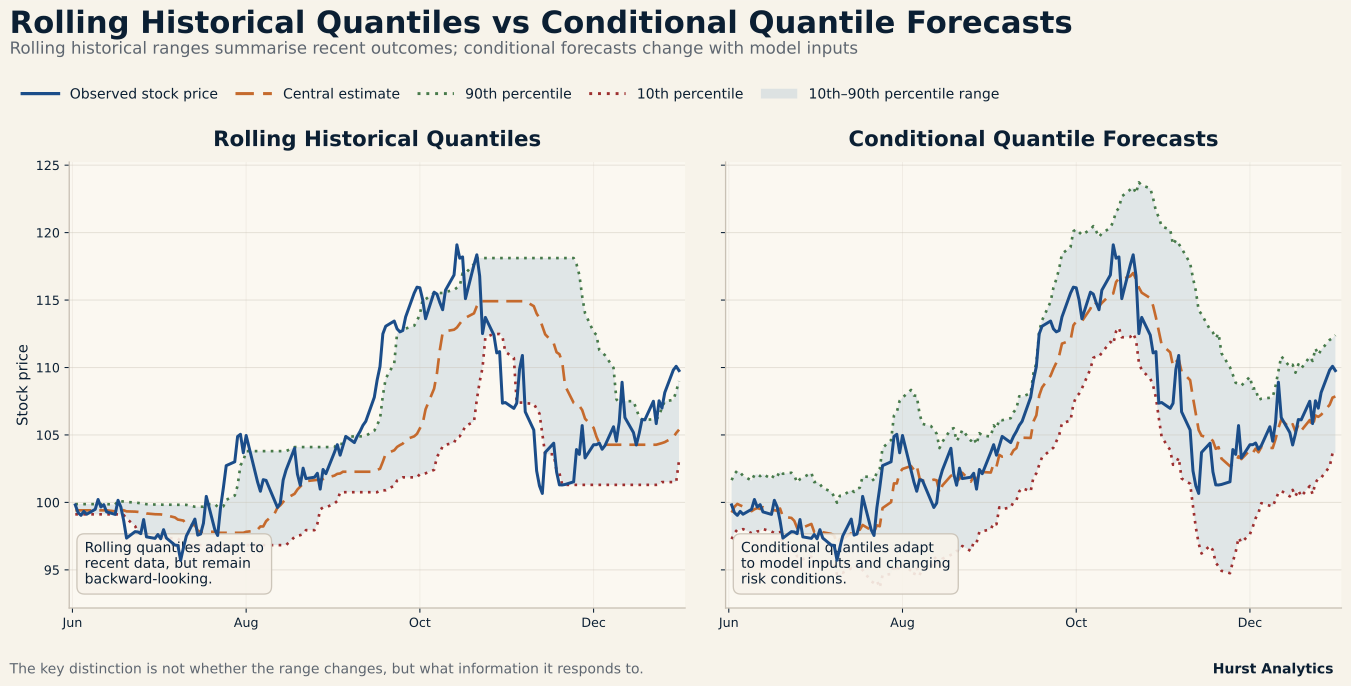
Quantile regression differs from simply looking at historical quantiles because it takes current conditions or observation-specific differences into account.
Historical quantiles provide a useful summary of past outcomes. However, they are usually backward-looking. Even rolling historical quantiles, while more responsive than fixed historical summaries, still depend on recently observed data rather than a broader model of current predictors.
Quantile regression estimates quantiles conditional on the information used by the model. By estimating multiple quantiles, such as the 10th and 90th percentiles, we can form a conditional prediction range that changes depending on the model inputs. Recent volatility might widen the range, while stable conditions might narrow it.
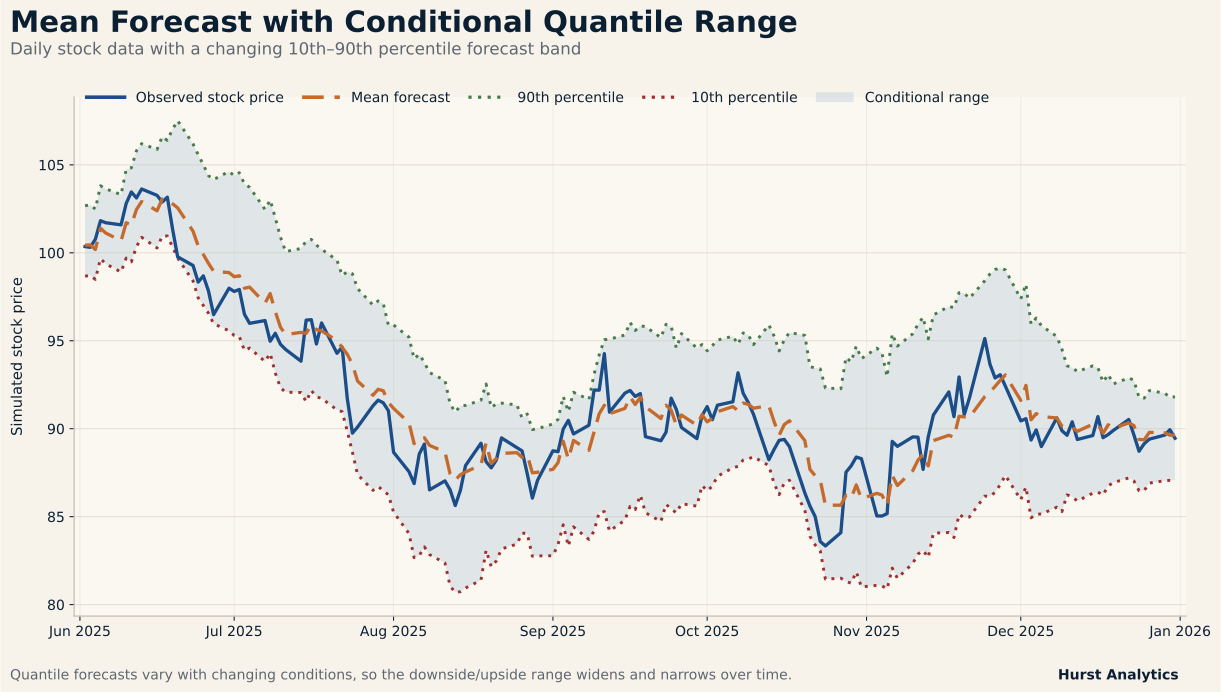
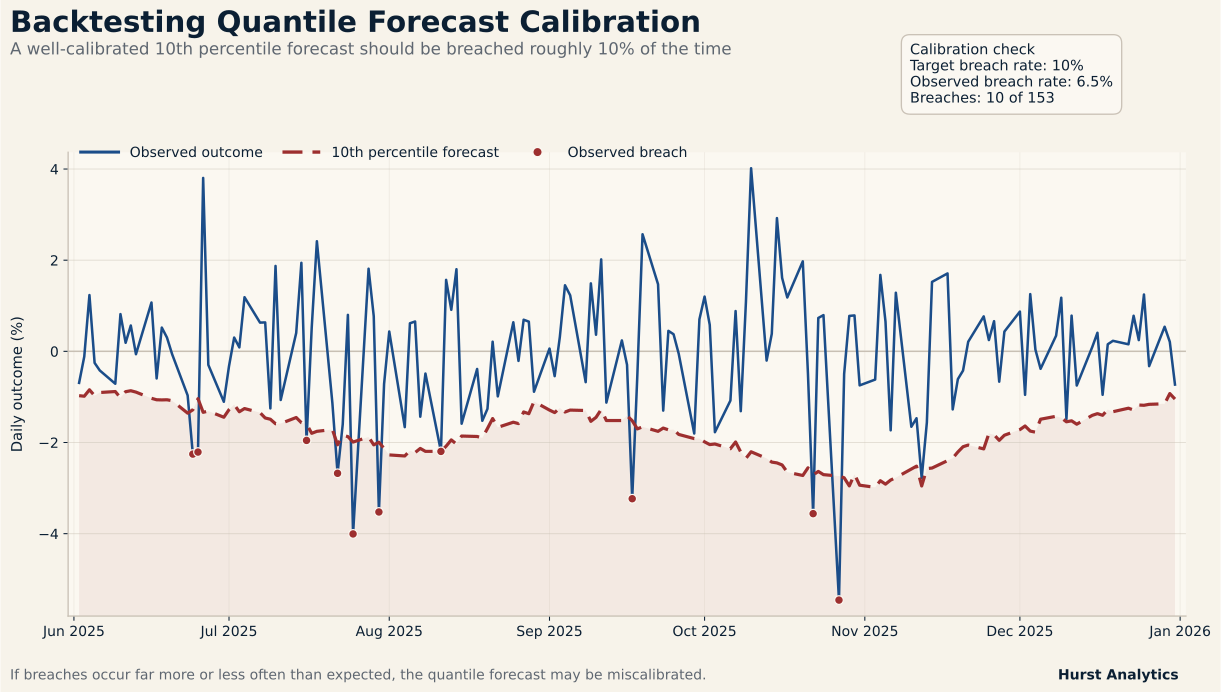
Quantile regression can also estimate how variables are associated with possible downside and upside outcomes. If the model is well calibrated, then over repeated forecasts, observed outcomes should fall below the 10th percentile prediction roughly 10% of the time, conditional on the information used by the model.
Historical Quantiles Versus Conditional Forecasts
Historical quantiles can be useful as descriptive statistics, especially when a team wants a quick view of realised downside or upside outcomes. A rolling window can make those summaries more responsive to recent data.
Conditional quantile forecasts are different. They use model inputs to estimate the relevant part of the outcome distribution for the current situation. That makes them especially useful when risk changes with volatility, seasonality, macroeconomic conditions, customer mix, operational constraints, or other predictors.
A Simple Demand Forecasting Example
Consider a business forecasting weekly demand using a mean forecast and two conditional quantile forecasts.
| Forecast | Weekly demand |
|---|---|
| Mean forecast | 1,000 units |
| 25th percentile | 700 units |
| 75th percentile | 1,450 units |
The mean forecast is useful for general planning. However, the quantile forecasts can support decisions around staffing, inventory buffers, and risk tolerance.
In this example, suppose that 700 units sold is the cashflow break-even point. A calibrated 25th percentile forecast of 700 units suggests roughly a one-in-four chance of falling below break-even. That downside risk may be materially more important than the fact that the mean forecast remains positive.
This is the practical value of quantile regression. It allows decision-makers to move beyond a single expected value and consider the parts of the outcome distribution that matter most for the decision at hand. This kind of work fits naturally with forecasting and risk modelling workflows.
Quantile Regression Is Not a Worst-Case Machine
Quantile regression is usually more reliable for estimating bad-but-plausible outcomes than for estimating extremely rare events such as a 99.99% worst case.
Extreme tail estimates require much more data and should usually be supported by additional stress testing or specialised risk methods. Quantile regression can be valuable, but it should not be treated as a complete substitute for scenario analysis, stress testing, or domain expertise.
Practical Use and Limitations
Using quantile regression well depends on understanding several limitations:
- Uncertainty can never be eliminated.
- Reliability depends on data quality.
- Backtesting is recommended.
- Extreme events can still exceed historical data.
A model should not be trusted simply because it produces a statistical output. The forecasts need to be checked against realised outcomes and interpreted in the context of the decision being made. This is where model comparison, validation, and careful interpretation become important.
Backtesting and Calibration
Backtesting can greatly increase confidence in a quantile regression model. For example, if you estimate a 10th percentile model and then backtest it, observed values should fall below the 10th percentile forecast roughly 10% of the time. If realised outcomes fall below the forecast 25% of the time, the model is likely underestimating downside risk. If they only fall below 2% of the time, the model is probably too conservative.
From Forecasts to Decision Systems
The real value from quantile regression does not come from uncritical acceptance of the statistical output. It comes from using conditional predictions as evidence within repeatable decision systems.
These forecasts can support:
- recurring risk reports;
- automated alerts;
- planning dashboards;
- downside-risk monitoring;
- portfolio exposure controls;
- operational decision workflows.
In practice, quantile regression is most useful when it is connected to a broader reporting or monitoring system. The model produces conditional forecasts, but the business value comes from turning those forecasts into timely, interpretable decisions through data systems, dashboards, or forecasting and risk modelling.
Next Steps
Related work can extend this approach into full distributional forecasting, machine-learning methods for quantile prediction, and forecast combination for improving overall model accuracy. These methods are most useful when they support clear monitoring, reporting, and planning decisions.
If scenario planning, downside-risk forecasting, or automated reporting would benefit your organisation, send Hurst Analytics an enquiry message to discuss whether a practical risk management or planning system could be built around your data.